If you work with technology at a strategic level, you know the difference between building on solid foundations and building on sand.
You know that every architectural choice has long-term consequences. That vendor lock-in is a real risk. That data ownership isn't a detail, but a strategic asset. That infrastructure must scale, evolve, integrate.
Yet, when it comes to "digital presence" and "engagement," many organizations continue to build their strategy on third-party platforms, accepting technical and business limitations that would be intolerable in any other context.
The Problem of Distributed Architecture (On Someone Else's Property)
As a technical leader or system integrator, consider this scenario:
Your client (or your company) has invested years building an audience on social platforms. Thousands of followers, decent engagement, content published daily. Then:
The algorithm changes. Organic reach drops dramatically
APIs get modified or deprecated without notice
User data is accessible only in limited formats
Platform policy changes and restricts commercial use
The cost to reach your own audience increases exponentially
From an architectural standpoint, it's like building your core business on infrastructure you don't control, with non-existent SLAs that can change unilaterally.
No CTO would accept this scenario for critical systems. Yet this is exactly what happens when your entire community and engagement strategy depends on Meta, X, LinkedIn.
The Technical Question Becomes Strategic:
What are you really investing in?
Are you explaining or are you engaging?
Are you always talking or are you listening better?
Are you optimizing metrics or are you generating value?
Are you merely possessing data or are you knowing people?
Are you distributing content or are you facilitating conversations?
Are you counting followers or are you measuring trust?
Are you seeking audience or are you cultivating people?
Are you collecting likes or are you building belonging?
Are you pushing messages or are you earning attention?
Are you filling editorial calendars or are you feeding ecosystems?
Are you just selling or are you helping?
Are you planning campaigns or are you nurturing relationships?
Are you renting others' spaces or are you building your own home?
Are you segmenting lists or are you recognizing individuals?
Are you aggregating audience or are you forming culture?
Are you filling funnels or are you opening doors?
Community Platform as Proprietary Infrastructure
A white-label community platform isn't a "cute social network." It's a technological infrastructure that enables otherwise impossible business models:
From a technical perspective:
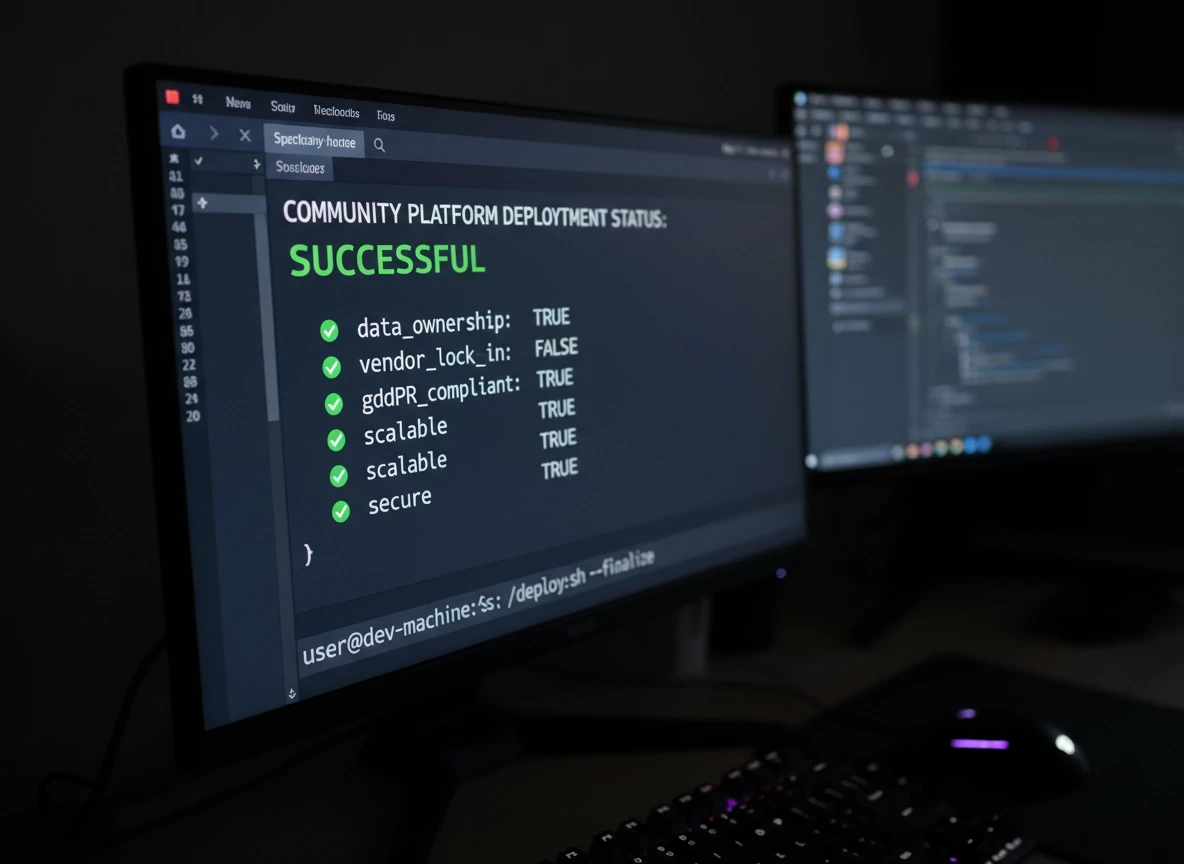
Complete data ownership: every interaction, every user data point, every behavioral pattern belongs to the organization
Native integration: open APIs for connection with CRM, marketing automation, analytics, proprietary systems
Controlled scalability: infrastructure dimensionable based on real needs, not pricing plan limits
Total customization: frontend, backend, business logic adaptable without platform constraints
Guaranteed compliance: GDPR, sector regulations, corporate policies implementable natively
Data Ownership in GDPR Compliance: True Control
When we talk about "data ownership," we don't simply mean having access to user data. We're talking about legal possession, operational control, and total data portability, in full compliance with GDPR.
With a proprietary community platform:
You are the Data Controller: you don't delegate the role of data controller to third parties, maintaining full responsibility and control over personal data management policies
Guaranteed portability: ability to export the dataset in standard formats (JSON, CSV, XML) without loss of information
Right to erasure implementable: when a user exercises the right to be forgotten, you can actually delete their data from your system, not just "hide it" as happens on third-party platforms
This level of control isn't a legal detail: it's a fundamental architectural requirement for any organization that wants to build lasting digital relationships.
True data ownership means: if tomorrow you decide to migrate technology, change provider, or bring everything in-house, you can do it without losing your data and without discovering that "technically" the data wasn't really yours.
Modern Architecture: Hub & Spoke Model
The paradigm shift isn't "abandoning social media," but repositioning it architecturally:
Hub (Proprietary community): where deep relationships live, data resides, structured conversation happens, lasting value exists
Spoke (External channels): for acquisition, amplification, reaching new audiences → but always with CTA toward the hub
This model guarantees:
Resilience: if a social channel changes policy or disappears, the core infrastructure isn't impacted
Ownership: the most valuable data and relationships live on controlled property
Flexibility: new channels can be added or removed without refactoring the core architecture
The Right Time to Propose (or Adopt) a Community Platform
Are you in one of these scenarios?
You're designing a digital transformation for an enterprise client
You need to build a scalable customer success hub
You want to launch a proprietary membership/subscription model
You need a direct channel with end users without intermediaries
You're building a product-led growth engine for a SaaS
You want to reduce dependency on advertising and social network algorithms
Then it's time to include a community platform in your next technology stack.
Not as an accessory feature. As a strategic infrastructural component.
Build on Your Own Servers, Not Someone Else's
Every line of code written to integrate yet another social API is an investment in someone else's property. Every advertising campaign is rent you pay for space you don't own.
It's time to build proprietary infrastructure.
As a developer, CTO, or system integrator, you know that architecture determines the limits of what's possible. And you know that building on solid, proprietary, controllable foundations is always the winning choice in the long run.
A Community platform isn't a marketing "nice-to-have." It's a strategic component of modern digital infrastructure, with impact on customer success, product development, revenue model, and competitive advantage.
What infrastructure are you building on?